
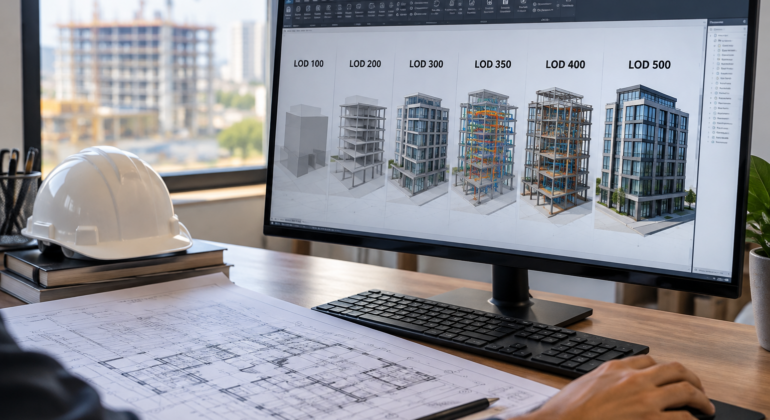
Level of Development (LOD) is an important concept in Building Information Modeling (BIM). It describes how developed, accurate, and reliable the information in a BIM model is at different stages of a construction project.
As a project moves from concept to construction and operation, BIM information becomes more detailed and reliable. LOD helps architects, engineers, contractors, and facility managers understand what information they can use at each stage.
What Does LOD Mean in BIM?
LOD stands for Level of Development. It does not simply describe how detailed a 3D model looks.
Instead, LOD indicates how much reliable information has been developed for a model element. For example, a structural column may begin as a simple conceptual object and later include accurate dimensions, structural information, fabrication data, and installation details.
The main LOD stages are:
- LOD 100: Conceptual information
- LOD 200: Approximate design information
- LOD 300: Accurate design information
- LOD 350: Coordination and system interfaces
- LOD 400: Fabrication and construction
- LOD 500: Verified as-built information
These levels do not mean that the entire project must reach the same LOD at the same time. Different building elements can develop at different rates.
LOD 100: Conceptual Design
LOD 100 represents the early concept stage. The BIM model shows the general size, shape, location, orientation, and purpose of the building.
The information is still approximate, so it is mainly useful for early planning, feasibility studies, and initial decisions.
LOD 200: Preliminary Design
At LOD 200, building elements become more clearly defined. Components have approximate sizes, locations, quantities, and orientations.
This stage supports preliminary coordination and allows design teams to evaluate different solutions before detailed design begins.
LOD 300: Detailed Design
LOD 300 provides accurate information about model elements. Dimensions, locations, quantities, and orientations are developed to a level that supports detailed design and coordination.
This information can also support quantity takeoffs, construction documentation, and project planning.
LOD 350: Coordination
LOD 350 focuses on how building systems connect and interact.
For example, a BIM model may show how ducts, pipes, structural elements, supports, and other systems fit together. This makes LOD 350 particularly useful for clash detection and construction coordination.
LOD 400: Fabrication and Construction
At LOD 400, model elements contain detailed information for fabrication and installation.
Contractors and manufacturers can use this information for shop drawings, fabrication, assembly, and construction activities. It moves BIM beyond design and closer to actual project execution.
LOD 500: As-Built Information
LOD 500 represents verified information about the completed building. The BIM model is updated to reflect what was actually installed.
It can include information such as equipment details, maintenance data, warranties, manufacturer information, and inspection records. This makes LOD 500 useful for facility management and asset management after construction.
LOD vs Level of Detail
LOD is often confused with Level of Detail, but they are not the same.
Level of Detail mainly refers to the visual or geometric complexity of a model. Level of Development focuses on the reliability and usefulness of the information connected to a model element.
A model can look highly detailed but still contain incomplete or unreliable information. Therefore, a visually complex model does not automatically mean it has a high LOD.
Why Is LOD Important in BIM?
Clear LOD requirements help project teams understand what information should be available at each stage. This can improve communication, coordination, quantity takeoffs, clash detection, construction planning, and facility management.
Key benefits include:
- Better BIM coordination
- More reliable project information
- Improved quantity and cost planning
- Earlier clash detection
- Less design rework
- Better fabrication and installation
- Improved facility management
Conclusion
LOD in BIM provides a clear way to manage the development of model information throughout a construction project. From the conceptual information of LOD 100 to the verified building information of LOD 500, each stage supports different project needs.
Understanding LOD helps BIM teams create the right level of information at the right time without producing unnecessary detail too early.




Recent Comments