
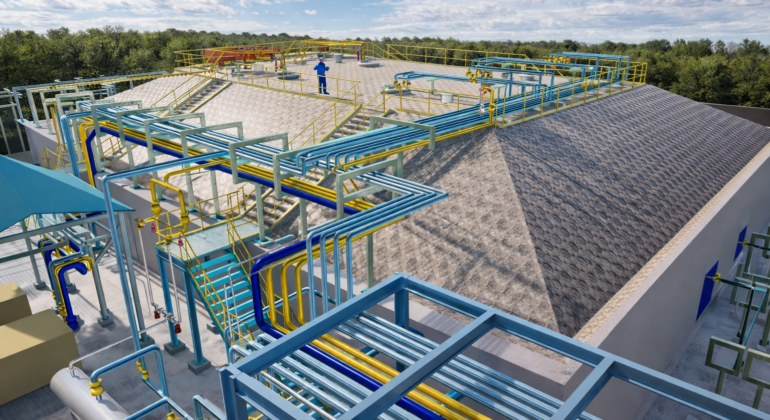
TakViksh successfully executed multidisciplinary Basic Engineering, FEED, and Detailed Engineering for an LPG Mounded Bullet Storage Facility for a prestigious organization under the Government of Kerala, India.
To better understand the significance of mounded storage systems, let us deep dive into LPG bullets—their configuration, purpose, operating principles, and why they remain one of the most widely used solutions for pressurized LPG storage.
1. Introduction to LPG Mounded Bullet Storage
LPG mounded bullet storage refers to horizontal cylindrical pressure vessels (bullets) that are covered with compacted earth or sand to provide passive fire protection and enhanced safety.
These systems are widely adopted across refineries, LPG bottling plants, petrochemical complexes, and industrial fuel storage facilities, especially where risk mitigation and regulatory compliance are critical.
2. Why Mounded LPG Storage is Preferred in Modern Facilities
Key Industry Drivers
- Increasing urban proximity to industrial facilities
- Stringent PESO and OISD safety regulations
- Need for BLEVE risk mitigation
- Demand for lower hazard footprint
Mounded storage provides a passive safety system, unlike above-ground tanks that rely heavily on active firefighting.
3. Engineering Design Criteria for LPG Mounded Bullets
3.1 Mechanical Design Standards
- Design Codes: ASME Section VIII, PD 5500
- Design Pressure: 14 ~ 18 bar
- Material: Low-temperature carbon steel (ASTM A516 Grade 70)
- Corrosion Allowance: 1.5 ~ 3 mm
3.2 Mound Design Parameters
| Parameter | Typical Range |
|---|---|
| Mound thickness | 1.0 – 1.5 m |
| Soil type | Sand / inert soil |
| Compaction | 90–95% |
| Slope | 1:2 |
3.3 Safety & Layout Considerations
- Reduced separation distances (OISD-150 compliant)
- Hazardous area classification (Zone 1 / Zone 2)
- Fire access roads and drainage systems
4. Functional Role of LPG Mounded Bullets
Core Functions
- Storage of LPG in liquid phase under pressure
- Buffer storage for distribution systems
- Stabilization of supply-demand fluctuations
Safety Functions
- Thermal insulation from fire exposure
- Prevention of vessel overheating
- Reduction of vapor dispersion
5. Risk Analysis & Safety Mechanisms
5.1 Major Hazards in LPG Storage
| Hazard | Description |
| BLEVE | Explosion due to vessel rupture under fire |
| VCE | Vapor cloud explosion |
| Jet Fire | Pressurized release ignition |
| Pool Fire | Liquid LPG ignition |
5.2 Risk Reduction in Mounded Tanks
✔ Soil cover acts as natural thermal insulation
✔ Prevents direct flame impingement
✔ Reduces pressure build-up
✔ Minimizes BLEVE probability
6. Advantages of LPG Mounded Bullet Storage
Key Benefits
- High Safety Integrity
- Reduced Fire Risk
- Lower Hazard Zone Radius
- Compliance with PESO & OISD norms
- Longer service life
- Better environmental integration
7. Limitations & Challenges
Considerations
- Higher capital expenditure
- Complex inspection and maintenance
- Leak detection challenges
- Requires proper drainage and cathodic protection
8. Applications Across Industries
LPG mounded bullets are extensively used in:
- LPG bottling plants
- City gas distribution stations
- FMCG and food processing industries
- Ceramics and glass manufacturing
- Refineries and petrochemical plants
9. Comparison with Other LPG Storage Types
| Parameter | Mounded Bullet | Above-Ground Bullet | Sphere |
| Safety | Very High | Moderate | High |
| Capex | High | Low | Very High |
| Land Requirement | Low | High | Medium |
| Maintenance | Moderate | Easy | Complex |
| Risk | Very Low | High | Moderate |
10. Regulatory Compliance (India & Global)
11. Future Trends in LPG Storage Technology
- Smart tank monitoring (IoT-enabled)
- Predictive maintenance using AI
- Advanced corrosion-resistant coatings
- Modular LPG storage solutions
12. Why Mounded LPG Storage is the Future
With increasing urbanization, shrinking industrial buffer zones, and more stringent process safety regulations, mounded LPG storage is steadily becoming the preferred benchmark for modern LPG installations. Industries today are no longer evaluating storage systems only on capital cost, but on lifecycle safety, risk reduction, regulatory compliance, land optimization, and long-term asset reliability—all areas where mounded bullets offer significant advantages.
As regulatory authorities and project developers place greater emphasis on inherently safer design philosophies, mounded storage aligns strongly with this approach by providing passive protection, rather than relying solely on active firefighting and emergency response systems. The reduced susceptibility to BLEVE scenarios, lower thermal radiation exposure, and minimized hazard footprint make mounded bullets particularly suitable for facilities located near populated zones, industrial clusters, and expanding urban developments.
Another reason mounded storage represents the future is its fit with modern risk-based engineering and sustainability goals. Reduced fire risk can translate into lower emergency infrastructure loads, improved insurability, and lower long-term risk management costs. In many projects, despite higher initial capital investment, the total cost of ownership can be favorable when considering safety benefits, regulatory acceptance, and reduced operational exposure.
With the rise of smart monitoring technologies, predictive maintenance, digital asset management, and automated safety systems, mounded bullets are also evolving into highly reliable, technology-enabled storage solutions rather than merely passive containment systems.
Perhaps most importantly, many newer LPG terminals and revamp projects are moving from conventional above-ground bullets toward mounded systems because they support a future-ready balance of:
- Higher safety integrity
- Better land utilization
- Improved environmental and community protection
- Greater regulatory resilience
- Long-term operational sustainability
In this context, mounded LPG storage is not merely an alternative storage option—it is increasingly viewed as the direction in which safe hydrocarbon storage infrastructure is evolving.
Executive Summary
- Mounded LPG bullets provide superior passive safety
- Reduce BLEVE and fire risks significantly
- Ideal for urban and industrial installations
- Higher initial cost but long-term safety ROI is high
- Strong compliance with PESO, OISD, and global standards



Recent Comments