
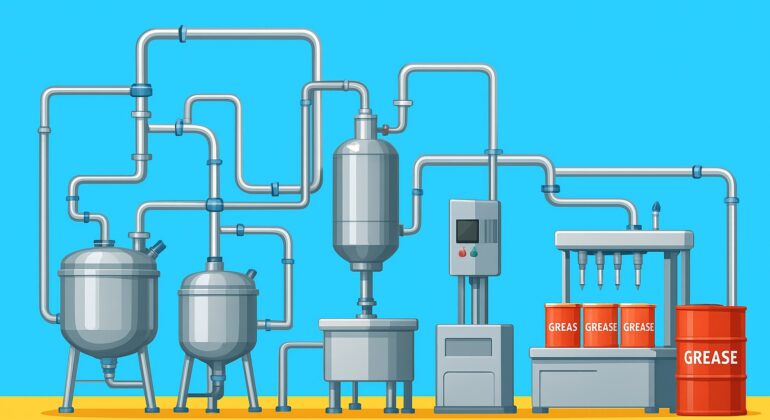
Titanium Complex Grease represents the next generation of high-performance lubricants used in heavy industrial applications such as steel plants, marine machinery, mining equipment, and high-temperature bearing systems. Its superior load-carrying capacity, excellent oxidation stability, and resistance to extreme conditions make it a preferred choice where conventional greases fail.
Producing such a complex formulation requires not only precision in chemical processing but also robust engineering across mechanical, electrical, and instrumentation disciplines. Let’s explore how a modern titanium complex grease manufacturing plant is designed, engineered, and executed from concept to commissioning.
Process Overview
The titanium complex grease manufacturing process integrates chemical reaction engineering with mechanical processing and thermal control. It typically begins with the preparation of the soap thickener, followed by controlled reaction, dehydration, and blending with additives. The finished product is then homogenized, filtered, and packed under stringent quality supervision.
The overall flow comprises:
-
Raw Material Charging – Base oil, fatty acids, and alkali are measured and loaded.
-
Saponification & Complexing – Reaction in a high-pressure reactor to form titanium complex soap.
-
Dehydration – Removal of moisture and residual water to ensure proper grease structure.
-
Homogenization – Ensures uniform dispersion and smooth texture.
-
Filtration & Filling – Final quality step before packaging into drums or cartridges.
Key Equipment in Titanium Complex Grease Production
A modern grease plant such as the Titex facility integrates the following critical equipment:
-
Reactors & Kettles: For saponification and soap complexing. Equipped with agitation, heating coils, and temperature/pressure control systems.
-
Homogenizers: Break down agglomerates and produce fine, stable grease texture.
-
Heat Exchangers & Cooling Systems: Maintain optimal reaction and processing temperatures.
-
Pipelines and Transfer Pumps: Designed for high-viscosity materials, ensuring smooth flow and minimal product loss.
-
Filters: Remove impurities before filling.
-
Filling Machines: Automatic or semi-automatic lines for drums, cartridges, or pails.
-
Instrumentation & Automation: SCADA-based control for temperature, viscosity, and pressure parameters, enhancing repeatability and process safety.
Process and Chemical Design Considerations
Producing titanium complex grease involves careful reaction kinetics management. The process chemistry includes saponifying a mixture of fatty acid and complexing agents with alkali, followed by the introduction of a titanium-based additive. Temperature profiles must be strictly maintained—typically 180–220°C during the reaction and 140–160°C during dehydration.
Design engineers must ensure:
-
Precise temperature control using thermic fluid or steam systems.
-
Batch integrity and traceability through digital logging systems.
-
Adequate venting and condensation during moisture removal.
-
Safety interlocks and flameproof equipment for high-temperature operations.
Basic Engineering (BDEP)
Basic Engineering transforms FEED concepts into design-ready documents and specifications.
For a grease plant, this includes:
-
P&IDs (Piping and Instrumentation Diagrams) for all process and utility systems
-
Equipment datasheets and specifications for kettles, reactors, and mixing systems
-
Preliminary civil and structural layouts for building, foundations, and support structures
-
Electrical single line diagrams (SLDs), power distribution, and motor control center design
-
Instrumentation logic diagrams, control philosophy, and automation architecture
-
Process safety studies like HAZID, HAZOP, and SIL review
-
Design basis report (DBR) covering key process and design assumptions
Basic Engineering forms the core of tender packages and guides the next stage of detailed design.
Front-End Engineering Design (FEED)
FEED lays the foundation for a technically and economically viable project.
In a grease manufacturing facility, FEED focuses on establishing:
-
Design capacity and throughput (e.g., tons per batch or per day)
-
Process flow diagrams (PFDs) and material balance
-
Preliminary equipment sizing (reactors, kettles, homogenizers, pumps, filters, etc.)
-
Plant layout studies ensuring safe and efficient material movement
-
Utility requirement definition – steam, thermic fluid, power, compressed air, water, and ventilation
-
HSE and process safety philosophy – including relief systems and ventilation control
-
Preliminary cost estimation (±20–30%) and project schedule outline
This stage enables the client to make informed investment decisions, aligning the process concept with financial feasibility.
Cost Estimation and Tendering
A robust cost and procurement strategy ensures that the project remains commercially viable.
Key elements include:
-
Bill of Quantities (BOQ) and Schedule of Rates (SOR) preparation
-
Itemized cost estimation covering mechanical, civil, electrical, and instrumentation disciplines
-
Vendor evaluation and technical bid analysis (TBA)
-
Tender document preparation, including scope of work, technical specifications, and data sheets
-
CAPEX estimation with sensitivity analysis for various production capacities
This stage links engineering with business objectives, helping clients make cost-effective procurement and contracting decisions.
Detailed Engineering
Detailed Engineering ensures every system is ready for construction, installation, and commissioning.
This multi-disciplinary phase integrates all domains:
-
Detailed design of reactors, agitators, homogenizers, pumps, and transfer lines
-
Pipe routing, isometric drawings, stress analysis, and material take-offs
-
Utility line integration (steam, thermic fluid, cooling water)
Civil & Structural:
-
Building layouts for production, packaging, storage, and utilities
-
Foundation design for heavy equipment like kettles and filters
-
Access platforms, pipe racks, and support structures
-
Detailed cable routing, lighting, earthing, and power distribution
-
PLC and automation panel design for process control
-
Field instrument selection and calibration plan
-
Hazardous area classification (HAC) and electrical zoning
-
Fire detection, alarm, and suppression system design
-
Process interlocks and emergency shutdown (ESD) systems
The output includes all construction drawings, MTOs, BOQs, and technical specifications for procurement and execution.
Sustainability, Automation, and Quality
Modern grease manufacturing plants are designed for:
-
Energy efficiency through optimized heating and cooling systems
-
Automation and batch control, reducing manual dependency
-
Emission control and waste minimization through closed transfer and vapor recovery systems
-
Digital integration for production monitoring, data logging, and predictive maintenance
These features enhance not just operational safety but long-term profitability and compliance.
Conclusion
Designing and engineering a grease manufacturing facility is far beyond the chemistry of lubrication—it’s a multidisciplinary engineering challenge that demands precision, integration, and foresight.
From Basic Engineering and FEED to Detailed Design, Cost Estimation, and Tendering, every stage contributes to building a safe, scalable, and efficient plant that meets both technical and commercial goals.
With the right engineering approach, expansions like the Titenium Grease (Titex) plant can achieve higher productivity, improved quality, and sustainable operation for years to come.



Recent Comments